LazyApply reviews (2026): is the LazyApply extension legit, and what does it cost?
Updated
We make Apiva. Read this knowing that.
Everything about LazyApply below comes from their homepage, their refund policy, their Chrome Web Store listing and their Trustpilot page, checked on 17 October 2026. Their prices are public, which is more than most of this category manages. Still, look at them yourself before you pay either of us.
Is LazyApply legit?
It's a real company. LazyApply is a product of PEVE VISIONS PRIVATE LIMITED, registered in Rewa, Madhya Pradesh, India, according to its own refund policy. The extension is live on the Chrome Web Store, and it does apply to jobs.
The reviews are poor, though. On 17 October 2026 Trustpilot rated it 2.1 out of 5 from 110 reviews, labelled Poor. Only 9 of those arrived in the last 12 months, and Trustpilot notes the company hasn't replied to negative reviews. The Chrome Web Store listing shows 3.4 out of 5 from 215 ratings, with 20,000 users.
Refunds exist, but read the conditions. Their policy offers a 30-day money-back guarantee on your first subscription only, not on renewals. You must have applied to fewer than 100 jobs, and refunds are only granted when the product "demonstrably fails to function as advertised". They may ask you for evidence. The policy is governed by the laws of India.
The short version
With Apiva, you approve each job and our AI fills in the application and submits it. Paid plans charge a monthly fee up front, and a credit from your allowance is only used once a submission is confirmed. If an attempt stops, no credit is used. You get 25 applications free every month, no card.
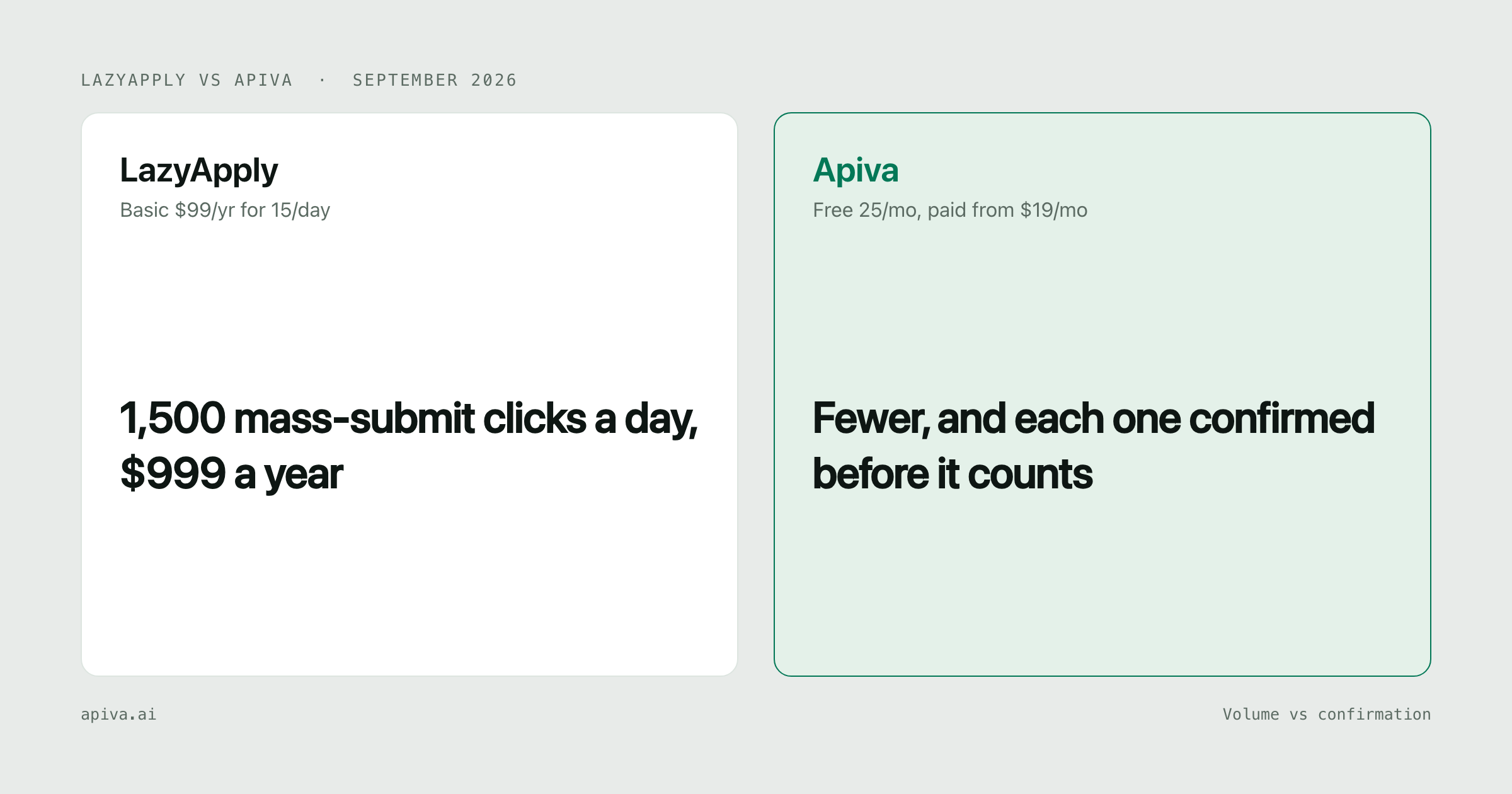
LazyApply sells volume. Its Chrome extension applies to jobs from your browser, up to 1,500 a day on the top plan, and every plan is paid a year at a time.
Our view is that most people are better served by applications they know went through, and that's what we built. But if you want the widest possible net and you're happy to pay for a year, LazyApply is cheaper on the sticker.
What you get with Apiva
You approve jobs from a feed built from a corpus of 50,000+ US company career pages, rescanned on a daily cycle. Or you paste a link to a US job you found yourself. Nothing goes out until you say yes.
Our AI fills in the form and rewrites your résumé for that role from your real experience. You can check what changed before it's sent.
Some forms ask things only you can answer. The app shows those as "Needs your answer" and picks up again once you reply. An attempt that stops partway is marked "Will be retried", and it doesn't use a credit.
When an application goes through, a confirmation is saved with it. You can open it whenever you like.
The LazyApply extension: what it does
LazyApply is a Chrome extension. You set up your profile and filters, click once, and it works through matching listings and applies for you.
Their homepage says it will "automatically apply to all the jobs on platforms like Greenhouse, Dice, Indeed and Ziprecruiter". The site's own description also names LinkedIn and Indeed, for jobs in the USA and Canada.
Paid plans differ by how many applications a day the extension will send and how many résumé profiles you can keep. The pricing section is further down.
Their pages don't describe any record that shows an application reached the employer. One five-star reviewer describes an analytics page with how many jobs went out, when, and which résumé was used.
What LazyApply reviews say
The low scores mostly come back to two complaints.
First, fields filled wrong or not at all. A February 2026 one-star review says "on my first 25 applications it could not even enter my First Name and/or Last Name." A May 2026 reviewer says visa and veteran questions were set to "yes" even though their profile said otherwise. That second one matters, because a wrong answer on a sponsorship question goes to the employer under your name.
Second, support. Several reviewers describe sending three or more emails with no reply. A June 2026 reviewer asked for a refund inside the 30-day window and says "it took two weeks to even get a response to let me know I was in the Queue."
It isn't all bad. A June 2025 five-star from someone three months in says about one in twenty submissions had a small error, like a phone number in the wrong format, and credits it with 15 plus interviews. If you want sheer volume and you'll check the results, some people clearly get value from it.
LazyApply pricing (checked October 2026)
Their pricing is on the homepage. Each price below is shown next to a higher crossed-out figure.
| Plan | Price | Daily limit | Résumé profiles |
|---|---|---|---|
| Basic | $99 / year (crossed out: $119) | 15 a day | 1 |
| Premium | $149 / year (crossed out: $179) | 150 a day | 5 |
| Ultimate | $999 / year (crossed out: $1,099) | 1,500 a day | 20 |
All three are billed yearly. The pricing section shows no free plan and no monthly option.
Each plan card asks for the email the plan should be added to, and says it "Must be a gmail account". So you need a Gmail address. A June 2026 reviewer signed up with Hotmail and says they were locked out after paying, then got no reply when they offered to switch.
One more thing for older customers. A January 2026 review says lifetime plans were cut "from unlimited to just 150 per day". We couldn't check that ourselves, so if you're on an old lifetime deal, ask them directly.
Apiva pricing
| Plan | Price | Applications a month |
|---|---|---|
| Free | $0, no card | 25 |
| Starter | $19 / month | up to 200 |
| Pro | $39 / month | up to 600 |
| Scale | $99 / month | up to 1,500 |
Every plan is the whole product, and the tiers only differ by volume. Quarterly prices ($49, $79 and $239) are published, but quarterly billing isn't open yet. Credits reset each month and don't roll over. If you cancel, you keep your plan until the end of the period you paid for, and a part-used month isn't refunded. Full detail is on the pricing page.
Use all 200 Starter credits in a month and each confirmed application costs roughly 10 cents. A lighter month means a higher cost per application.
Side by side
| LazyApply | Apiva | |
|---|---|---|
| What it is | A Chrome extension | An app where you approve jobs and our AI applies |
| Daily volume | 15 to 1,500 a day, by plan | Not what we compete on |
| How billing works | A year up front | Monthly fee up front; a credit is used only on a confirmed submission |
| Proof it went through | Their pages don't describe one | A saved confirmation per application |
| If an attempt stops | Their pages don't say | Marked "Will be retried", no credit used |
| Refunds | First 30 days, under 100 applications, product must fail | Part-used month not refunded; a held credit is released if you skip the job before it's sent |
| Free tier | None on the pricing page | 25 applications every month |
| Trustpilot | 2.1 / 5 from 110 reviews | No comparable base yet |
When LazyApply is the better pick
You want the lowest sticker price for automatic applying. $99 for a year of up to 15 a day is cheap, and they publish it openly.
Daily volume is your whole strategy. Ultimate allows 1,500 a day. If casting the widest net is your plan, that's the plan built for it.
When Apiva is the better pick
Credits that only get used on applications that went through. A credit is held when you add a job, released if you skip it before it's sent, and spent once the submission is confirmed.
You can see what happened to each one. A stopped application says why, whether it's waiting on your answer or due to be retried.
Sponsorship questions are answered only from what you've told us. So are identity questions like veteran status. If you haven't said, it picks the form's decline option or asks you. Given the review above about visa answers set to "yes", that's worth checking in any tool you use.
And monthly billing fits a job search better than a year up front. Cancel the day you're hired and the plan runs to the end of the month you paid for.
Bottom line
If you want the cheapest way to send a large number of applications and you're fine paying for the year, LazyApply's Basic plan is $99. Read the refund conditions first, and use a Gmail address.
If you'd rather approve each job, have it submitted for you, and only use credits on applications that went through, that's what Apiva does. Try it with 25 free applications a month, no card.
Before you pay anyone for a year, send their support team a question and see how long the answer takes. Given what LazyApply's reviewers say, it's a cheap test.
Checked 17 October 2026. Spot something outdated or wrong about either service? Tell us and we'll fix it.
LazyApply and its logo are trademarks of their owner, PEVE VISIONS PRIVATE LIMITED, shown here to identify the product under comparison. We aren't affiliated with them and they haven't endorsed this.