LoopCV vs Apiva: applications, or emails? (2026)
We make Apiva. Read this knowing that.
Everything here about LoopCV comes from their pricing page and homepage, and from their Trustpilot, all checked October 2026. Two catches before you compare. Their prices are shown in your local currency, so a European reader sees euros where we, reading from the US, saw dollars. And their own FAQ still says paid plans start from €9.99 a month while the plan cards read $19.99, so read the card and not the FAQ. Prices change. Click through before you spend money on either of us.
The 10-second version
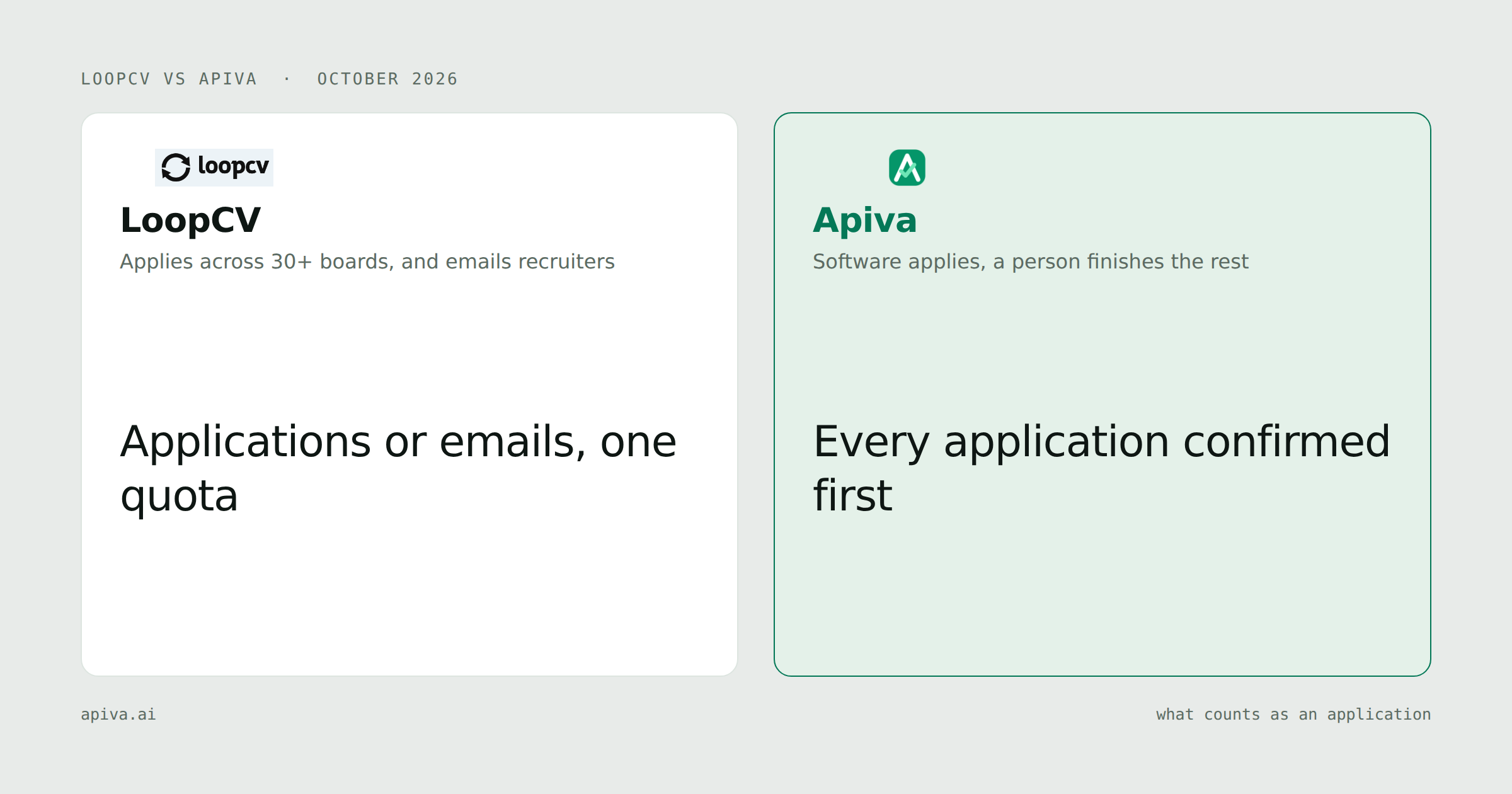
LoopCV: software that applies to jobs for you across 30+ job boards and also emails recruiters directly. Its plan quotas are counted in "applications or emails per month," so an outbound email and a submitted application spend the same unit. Free tier is 10 a month. Paid plans read $19.99, $59.99 and $89.99 a month.
Apiva: software applies to the jobs you approve, a person finishes anything it cannot, and a credit is only spent when the submission is confirmed. Free tier of 25 confirmed applications a month, no card. Paid plans from $19.
Want the maximum number of touches out each month, and an email to a recruiter counts as one of them? Them.
Want the application itself confirmed as received before it costs anything? Us.
What LoopCV actually is
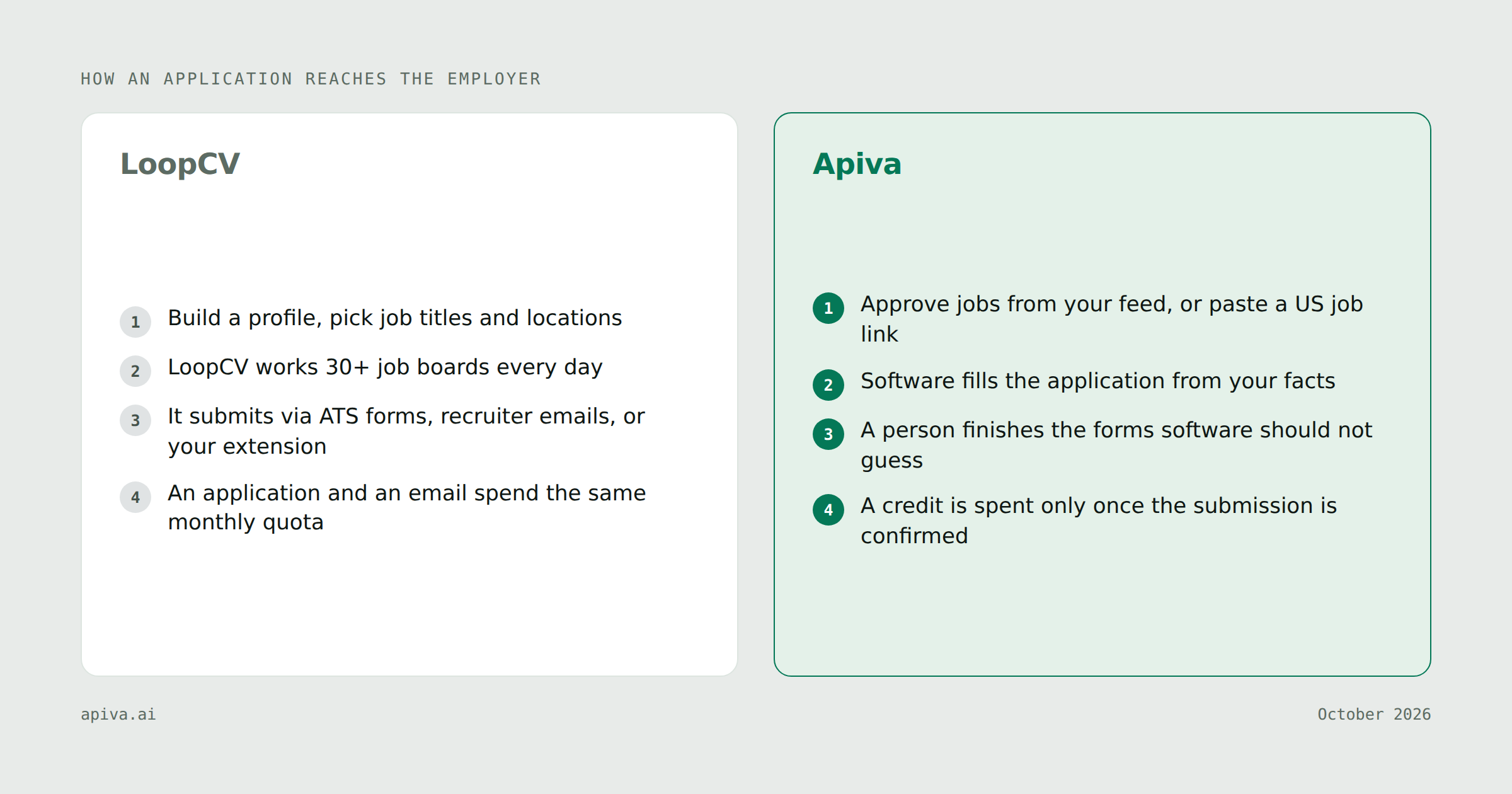
LoopCV automates the search and the sending. You upload a CV, pick job titles and locations, and it works through matching postings on your behalf.
Their homepage lists the ways it sends. One is "using a browser extension, form submissions via ATS." Another is "automated emails to recruiters." On the email side it says: "We automatically find the email of the recruiter in a company sending a personalised email."
So an application can arrive as a filled ATS form, or as an email in a recruiter's inbox. Both are outreach. Both come back to you as activity in the same dashboard.
Their assurance about the form half is that "Employers see a normal application without an automation label."
Around that core there is more. A CV builder. AI CV checks. A/B testing of CVs, which is genuinely unusual. A job tracker, and a Chrome extension for boards that need you logged in.
On Trustpilot it holds 3.9 out of 5 from 131 reviews, read October 2026, and the company replies to every negative review within about two weeks. Reviewers name individual support staff by name, which you rarely see.
What counts as an application
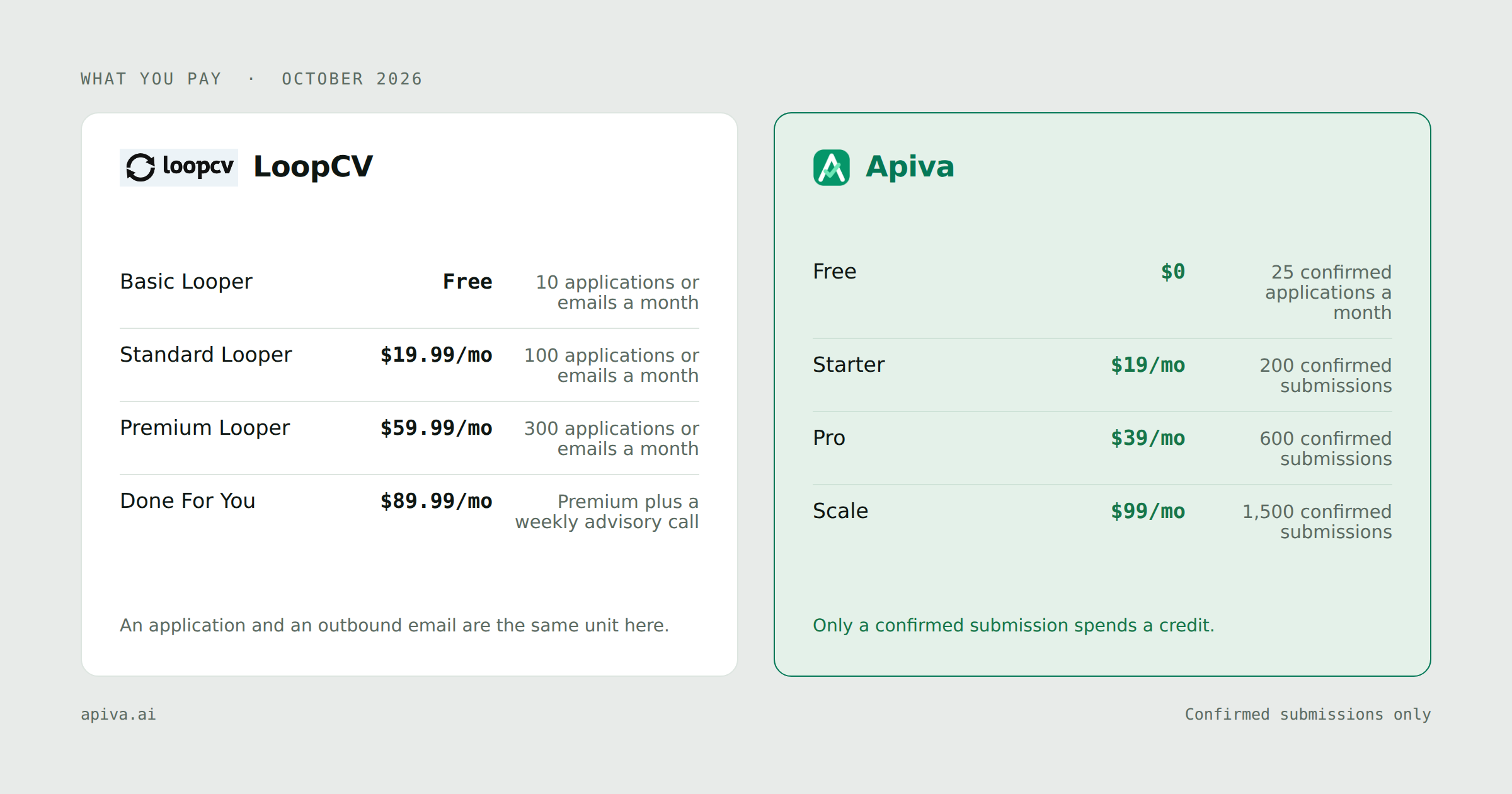
Every LoopCV plan is priced in the same unit, and the pricing page prints it on each card. Basic Looper gives "up to 10 applications or emails per month." Standard Looper gives "up to 100." Premium Looper gives "up to 300."
Read the word "or" slowly. That quota fuses two different actions into one number. One is an application, submitted to an employer's system for a specific job. The other is an email sent to a recruiter's inbox. They are not the same act, and the card does not tell you the split between them.
An email is worth sending. It is not applying.
This matters more than it looks, because the gap between "applied" and actually submitted is the most common complaint about tools in this category. Remote Job Assistant, which sells a competing auto-apply product, ran LoopCV's Premium plan for 14 days in May 2026 and audited the results. Of 47 jobs showing "Applied" in the dashboard, they found only 16 had actually submitted. The other 31 sat queued. Read that test with the caution it deserves, since the reviewer sells a rival. The shape of it, though, is the failure this whole category shares: a status that says applied while nothing left the building.
We have written about both ends of this market. LazyApply is the high-volume, low-touch end. JobCopilot is AI that applies for you on your behalf. LoopCV sits between them, and the middle is exactly where the quota wording starts to matter. Scale.jobs is the far end, where a person does every form.
What Apiva actually is
We sell the applied-and-confirmed application. One credit buys one of those.
You approve jobs from a feed, or paste a US job link you found yourself. Software fills it in, with your résumé rewritten for that role. When a form fights back, a person finishes it by hand. The credit is spent then, and only then.
No email counts as an application here, because we do not send recruiter emails. A credit is a confirmed submission, nothing else. If an application died on a validation error, it costs nothing. There is no refund to chase, because nothing was charged.
Side by side
| LoopCV | Apiva | |
|---|---|---|
| What it does | Applies for you, and emails recruiters | Submits the application and confirms |
| The quota | Applications or emails per month | Confirmed submissions only |
| Who submits | Software, on boards you are logged into | Software, a person finishes the rest |
| Recruiter emails | Yes, and they spend the same quota | Not something we do |
| Proof | A status in your dashboard | A saved confirmation per application |
| When you pay | Monthly, up front | Only when a submission is confirmed |
| Free tier | 10 applications or emails a month | 25 confirmed applications a month |
| CV tools | Builder, AI checks, A/B testing | Rewritten per role, you review first |
| Job sources | 30+ job boards and career pages | Any US job posting |
The money
LoopCV's plan cards, read October 2026:
| Plan | Price | Quota on the card |
|---|---|---|
| Basic Looper | Free | up to 10 applications or emails a month |
| Standard Looper | $19.99/mo | up to 100 applications or emails a month |
| Premium Looper | $59.99/mo | up to 300 applications or emails a month |
| Done For You | $89.99/mo | Premium, plus a weekly advisory call |
Their FAQ adds a 7-day refund window, allowed only if you have used under 10% of your plan's quota.
Do the division on the Standard plan. $19.99 for up to 100 applications or emails is about 20 cents a unit. That is a fair price for a submission. It is a poor price for an email, and the card will not tell you which you got. Buy it expecting 100 applications and a quiet share of the quota can be emails instead.
Ours is a plan, not a pack, and the unit has one meaning. Free is 25 confirmed applications a month, no card. Starter is $19 for up to 200, Pro is $39 for up to 600, and Scale is $99 for up to 1,500. Quarterly prices are $49, $79 and $239. Every tier counts confirmed submissions only, so $19 for 200 works out near nine and a half cents each. Details on the pricing page.
Where LoopCV wins
Reach. 30+ job boards and career pages, by their count. Our feed is US company career pages only, so their net is wider.
A free tier that runs. 10 applications or emails a month, forever, with no card.
Recruiter emails. An outbound channel we do not have at all. For contract and agency work, that channel is often the one that answers.
Standing and support. "25k+ jobseekers" by their count, and reviewers name the support staff who helped them. We are much newer.
CV experiments. Their A/B testing of CVs is real. We rewrite your résumé per role but never test one version against another.
Where Apiva wins
One unit, one meaning. A credit is a confirmed submission. No email shares the quota, so the number on the plan is the number of applications.
Proof, not a status. A saved confirmation per application, against a dashboard status you have to trust.
The stuck forms. A person finishes what software should not guess, so an awkward application is a pause rather than a silent failure.
What the money buys. $19 for up to 200 confirmed submissions, near nine and a half cents each, against $19.99 for up to 100 units that may include emails.
You pay for outcomes. Nothing is charged until a submission is confirmed.
Bottom line
If you want daily activity across many boards, including emails to recruiters, and a plan counted generously in touches per month, LoopCV will keep you busy. The free tier costs nothing to try.
If what you want is the application itself, sent to the employer's system and confirmed before it costs anything, that is the reason Apiva exists. Testing it is free: 25 applications a month, no card.
Either way, verify. Take a few applications you paid for and check them in the employer's own portal, whoever you use.
Checked October 2026. Spot something outdated or wrong about either service? Tell us and we'll fix it.
LoopCV and its logo are trademarks of their owner, shown here to identify the product under comparison. We aren't affiliated with them and they haven't endorsed this.