Jobscan vs Apiva: the score, or the submitted application? (2026)
We make Apiva. Read this knowing that.
Everything here about Jobscan comes from their pricing page, homepage, resume scanner, auto-apply page, their Trustpilot and Chrome Web Store listings, all checked October 2026. One catch before you compare: the price for auto-apply credits is not published on their plan page, and the 7-day free trial sits on the quarterly plan only. Prices change. Click through before you spend money on either of us.
The 10-second version
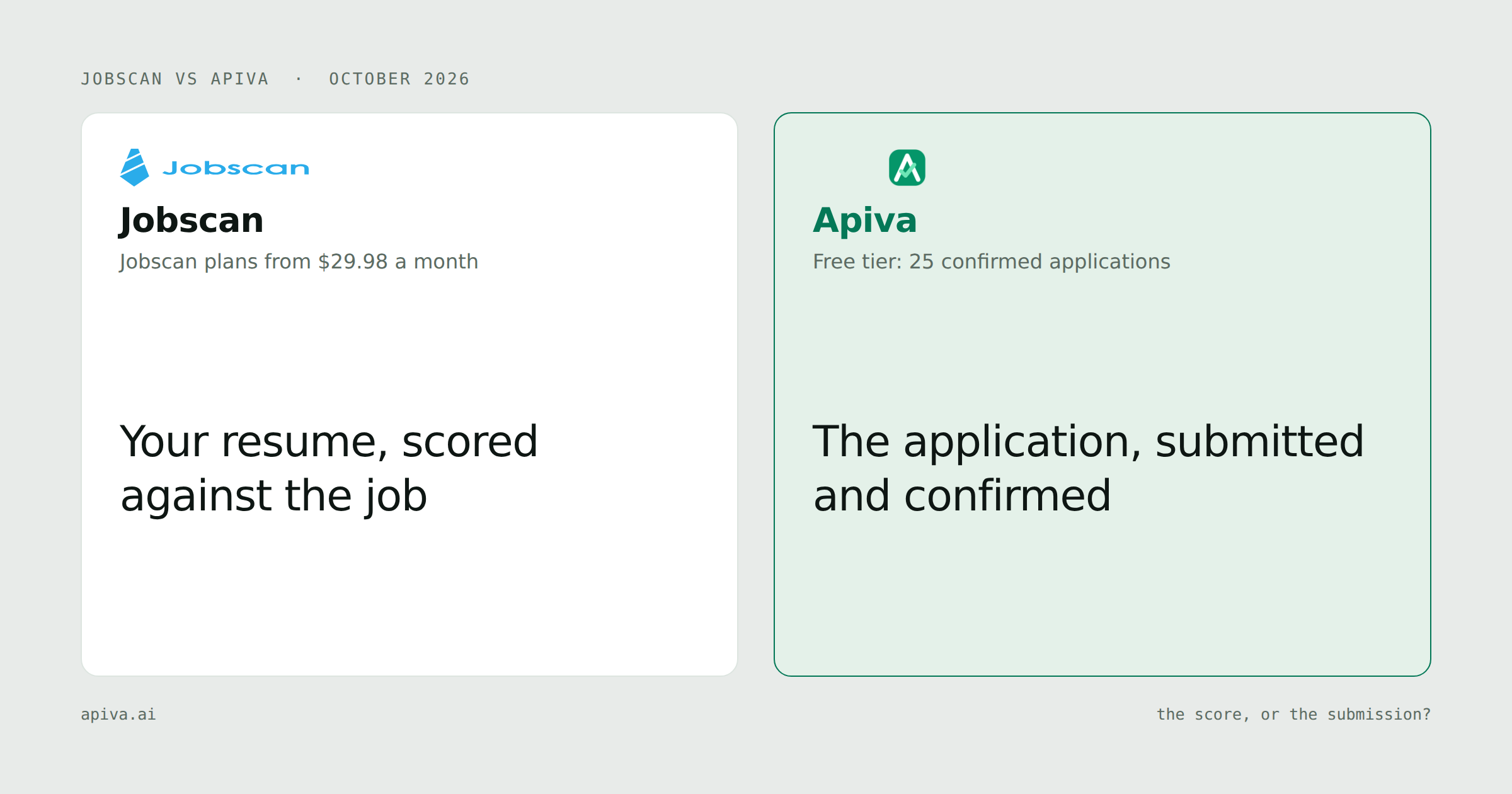
Jobscan: a scanner that scores your résumé against a posting before you apply, with a résumé builder, a tracker and a browser extension attached. Free plan is 5 scans a month. Paid is $49.95 a month, or $29.98 a month billed quarterly. They added auto-apply too, where you approve every application and press submit yourself.
Apiva: software applies to the jobs you approve, a person finishes anything it cannot, and a credit is only spent when the submission is confirmed. Free tier of 25 confirmed applications a month. Paid plans from $19.
Want to know your résumé's weak spots before you send it, and you are happy to send it yourself? Them.
Want the application sent and confirmed before it costs anything? Us.
What Jobscan actually is
A résumé scanner first. The homepage headline is "Optimize your resume for the exact ATS," and the product behind it scores your résumé against one specific posting.
The score is the whole idea. Jobscan compares your résumé to the job listing and returns a percentage. That number is built from five things, in their stated order: hard skills, education level, job title, soft skills, and other keywords. Their scanner page says the system runs "over 30 checks."
It is a résumé tool, and it is good at that job. The scanner names the keywords a posting uses and your résumé does not, which is the part almost everyone finds useful. There is a résumé builder, a template library, a tracker, and a Chrome extension that reads a posting while you browse.
Then there is the part they added more recently: auto-apply. On their auto-apply page they describe it as "an AI job application tool that handles matching, job search, and drafts tailored applications for you." It sources work from "Greenhouse, Lever, Workable, and 20+ ATS platforms," by their count.
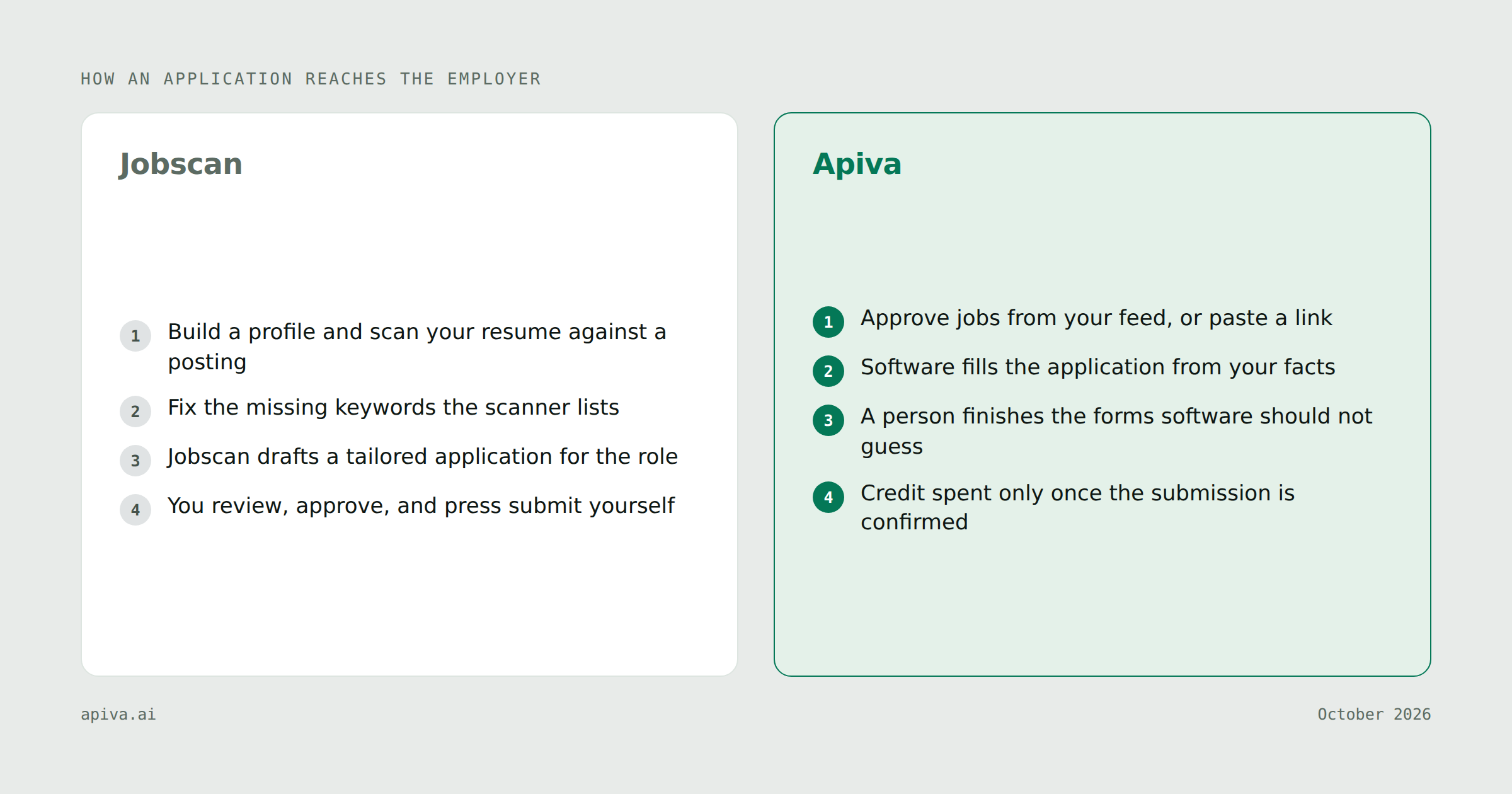
Their own copy draws the line on who is in charge. "Review, edit, and approve before anything is submitted. The Submit button is always yours." And, flatly, "Nothing submits without your approval." Their FAQ answers the obvious question the same way: "No. Every application goes through a review step before submission."
That is an honest design. It is also a different product from software that submits and then checks what came back.
The number no employer computes
This is the part most résumé-score pages leave out, and Jobscan is the one that says it out loud.
On their own resume scanner page, in the section explaining the score, is this sentence: "when you submit your resume to a job, the ATS doesn't score your resume. The match rate in our scanner is a visualization tool to help you measure the strength of your resume before you apply."
Read that twice. The employer's system does not produce a score. Jobscan's percentage is their own gauge, built to predict what an employer might think. No applicant tracking system hands a recruiter a number out of 100 with your name on it. The systems store, search, and filter.
Almost everywhere else in this category that distinction is buried or missing. Jobscan publishes it. Credit them for that, and it also tells you what the number is for: a pre-flight check, not a verdict.
Their guidance on the target is consistent and modest. The homepage recommends "a match rate score of 75%." The scanner page calls "75+" the target. A post on their own site says, "We generally recommend a match rate score of 80%," and warns against stuffing keywords to reach it, including the trick of hiding them in white text: "Never do this! This is risky and unethical."
We have covered the writing side elsewhere. Our résumé tips are about the words on the page, and a look at Rezi covers a builder with an ATS check of its own. Both stop where Jobscan stops: the résumé that is ready, and the application still sitting unsent.
What Apiva actually is
We do not publish a score. We submit the application.
You approve jobs from a feed, or paste a US job link you found yourself. Software fills in the application from your facts, with your résumé rewritten for that role. When a form fights back, a person takes over and finishes it by hand.
Then the part that separates it. The credit is only spent when the submission is confirmed. A failed application costs nothing. There is no refund to chase, because nothing was charged.
The difference is where each product ends. Jobscan ends at a percentage that predicts what an employer might do. We end at a saved confirmation that the employer's system received the application.
Side by side
| Jobscan | Apiva | |
|---|---|---|
| What it does | Scores your résumé against the posting | Submits the application and confirms |
| The number | Their own match rate, 75 to 80% target | None published, a confirmation instead |
| Who applies | You approve and press submit | Software, a person finishes the rest |
| Proof | A status in your tracker | A saved confirmation per application |
| When you pay | Monthly or quarterly, up front | Only when a submission is confirmed |
| Free tier | 5 scans a month | 25 confirmed applications a month |
| Auto-apply | Credit-based, approval required | The core product, included |
| Job sources | Greenhouse, Lever, Workable, 20+ ATS, by their count | Any US job posting |
| Résumé tailoring | Built in, the reason people subscribe | Included with each application |
The money
Their plans, from their pricing page, read October 2026:
| Plan | Price | Includes |
|---|---|---|
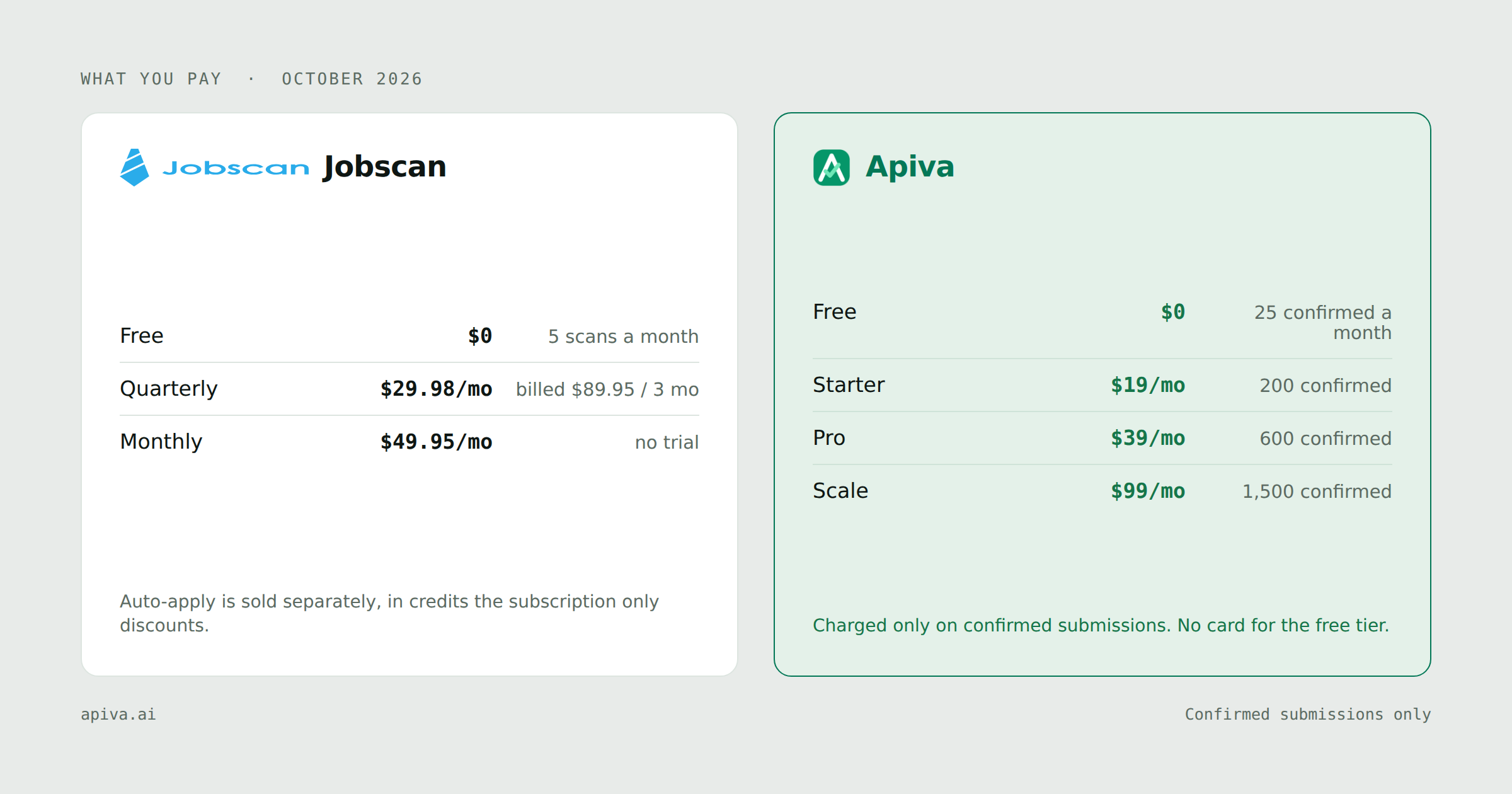
| Free | $0 | 5 résumé scans a month |
| Quarterly | $29.98/mo | billed $89.95 every 3 months, 7-day free trial, save 40% |
| Monthly | $49.95/mo | no trial |
The auto-apply credits are separate. The plan page shows subscribers get "20% off Auto Apply Credits," which tells you the credits are a purchase of their own and not part of the subscription. Their price for those credits is not on the plan page, so we do not quote one.
Ours is a plan, not a pack. The free tier is 25 confirmed applications a month, no card. Starter is $19 for up to 200 confirmed submissions, Pro is $39 for up to 600, and Scale is $99 for up to 1,500. Quarterly prices are $49, $79 and $239. Details on the pricing page.
Do the division and the units are what differ. Jobscan's $49.95 monthly buys unlimited scanning and drafting, not a number of applications. Pay it and apply to fifty jobs, and the résumé work is what you bought. Apiva's Starter is $19 for up to 200 confirmed submissions, about nine and a half cents each, and the sending is the thing you bought.
Their free plan is a real free plan, not a trial. Five scans a month, no card, and the scanner is the whole point of the product. If you want to fix your résumé and you are applying yourself, five free scans a month is a good deal, and no honest comparison should pretend otherwise.
Where Jobscan wins
Résumé quality. The scanner names the keywords you are missing from one posting, and that list is the most useful output in this category. It makes your résumé better.
Standing. 4.3 out of 5 from 344 reviews on Trustpilot, and 4.3 out of 5 with about 20,000 users on the Chrome Web Store, both read October 2026. They say "1,000,000+ job seekers" use them. Longer in market than us, by a wide margin.
A free plan that does the job. Five scans a month at no cost, with the builder and the tracker. Our free tier is 25 submissions and no scanner.
The number, used properly. Treat their score as a checklist and not a verdict, and it is a good checklist.
Where Apiva wins
We submit. The score stays theirs to publish. Our credit is tied to a confirmed submission, not to a percentage before you apply.
Confirmation, not a status. Their tracker shows a job as Applied because you approved it. Ours shows a saved confirmation that the employer's system received it.
No separate credit to buy. Auto-apply is the product here, not an add-on with its own price.
The forms software cannot do, a person finishes. Not every application is a clean autofill. Ours hands the stuck ones to a human instead of stopping.
Starting cost. $19 a month against $49.95, and ours is spent on submissions rather than on a subscription that runs whether you apply or not.
Bottom line
If your problem is the résumé itself, and you want to see what a posting is not seeing in it, Jobscan is the pick. Five free scans a month will tell you more about your résumé than any tool we ship.
If your problem is the applications, and you want each one sent and confirmed before it costs you anything, that is the entire reason Apiva exists. Testing it is free: 25 applications a month, no card.
Either way, verify. Pick a few applications and check them in the employer's own portal, whoever you use.
Checked October 2026. Spot something outdated or wrong about either service? Tell us and we'll fix it.
Jobscan and its logo are trademarks of their owner, shown here to identify the product under comparison. We aren't affiliated with them and they haven't endorsed this.