AIApply vs Apiva: pure AI, or AI plus a human? (2026)
We make Apiva. Read this knowing that.
Everything here about AIApply comes from their own site and help center, checked August 2026. They don't publish prices on a public page, only inside checkout, so click through and confirm before you buy either of us.
The 10-second version
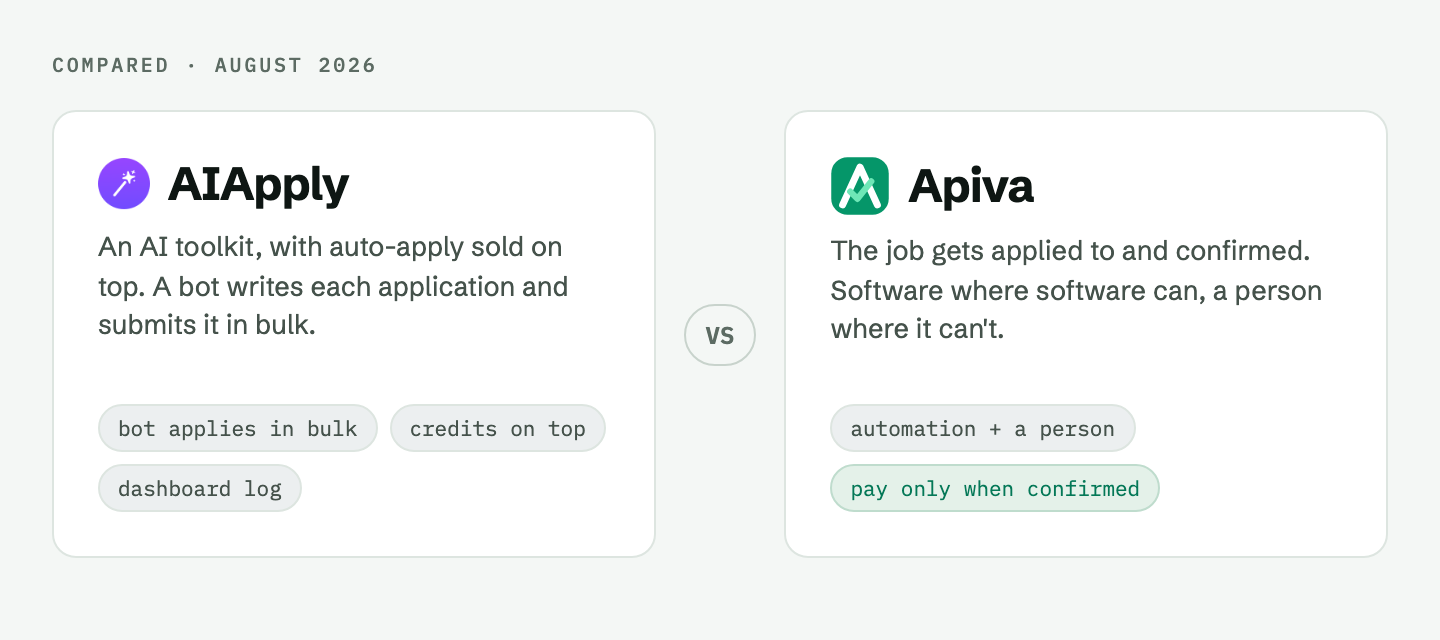
AIApply: an AI toolkit for $29 a month. Résumé builder, cover letters, mock interviews. Auto-apply is sold on top of that, as credits or a second subscription, and a bot submits applications for you in bulk.
Apiva: we get the job applied to, and confirmed. Software does it where software can, a person finishes it where it can't, and the credit is only spent once the submission is confirmed. Free tier of 25 a month, paid plans from $19 for up to 200 confirmed.
Want 100 applications fired off in an hour? Them.
Want to know each one actually landed? Us.
What AIApply actually is
It's really two products sold under one name, and the split matters when you work out what you'll pay.
The first is a toolkit. AI résumé builder, cover letter generator, interview prep, a mock interviewer. $29 a month, or $144 a year. If AI writing tools are what you're after, that's a fair price for them.
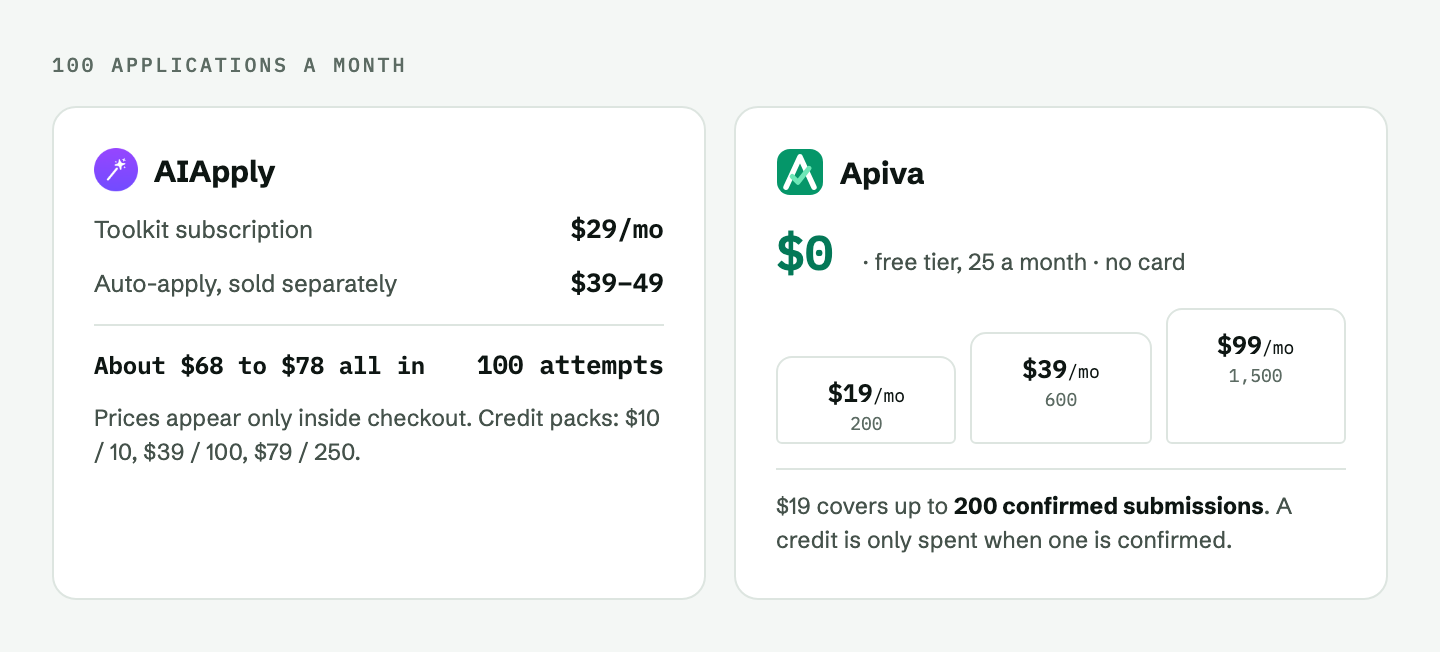
The second is auto-apply, and it costs extra. Credits come in packs ($10 for 10 applications, $39 for 100, $79 for 250), or as a separate subscription at $49 a month for 100. The $29 plan on its own doesn't apply to anything.
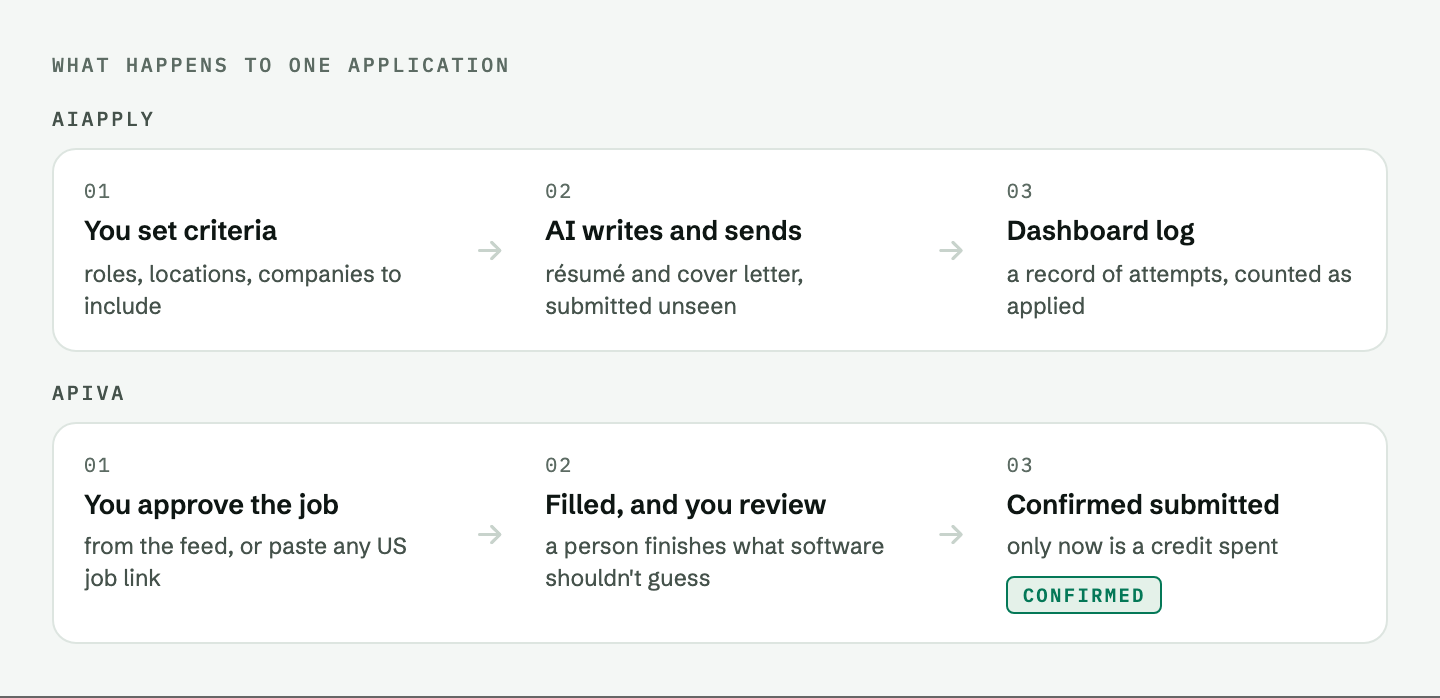
Here's their flow, as they describe it. Upload your résumé. Set your criteria. The AI writes a tailored résumé and cover letter for each match and submits it, in bulk. "100 in under an hour" is their line.
You aren't in that sequence anywhere. The résumé an employer reads under your name is one you never saw.
The proof question
Bot speed is real, and we're not going to pretend otherwise. If applications per hour is the number you care about, a bot alone wins that.
What you get back from AIApply is a dashboard. Where it applied, when, which résumé version. That's the tool reporting its own work back to you.
The gap is that clicking submit isn't the same as submitting. Forms throw validation errors after the click. Required questions a bot can't answer get skipped or guessed at. Multi-step applications die on page two. A dashboard counting attempts counts every one of those as applied.
Apiva saves a confirmation per application, with a screenshot, the moment it goes through. The credit is only spent at that point. If it doesn't go through you aren't charged, so there's no refund to chase.
What Apiva actually is
The thing we're selling is the applied-and-confirmed application. Not the software. The method is whatever that particular form needs.
You approve jobs from a feed built from 79,892 US company career pages, rescanned on a daily cycle. Or paste any US job link you found yourself.
Software fills in the application, with your résumé rewritten for that role. You can review what changed before it goes anywhere, and anything the résumé can't back up gets left out, not made up.
When a form fights back, a person takes over and finishes it by hand. You still get the one confirmation at the end, and you don't find out which route it took, because it doesn't change anything for you. Same proof, same single credit, either way.
That's the part worth being clear about. Most tools here are selling you a mechanism, and the mechanism decides what you get: a bot tool stops where the bot stops. Ours is the other way round. The job gets applied to, by software where software is enough and by a person where it isn't, and nothing counts as done until it's confirmed.
Approved applications go out within 24 hours of your approval. That is a commitment rather than an average, and it covers the awkward forms a person has to finish by hand. Every one is timestamped, so you can check the pace against your own record.
Side by side
| AIApply | Apiva | |
|---|---|---|
| What you're buying | A bot's attempts | Applications confirmed submitted |
| Who applies | A bot, in bulk | Software, a person finishes the rest |
| Speed | "100 in under an hour," their words | Within 24 hours of approval, committed |
| Proof | Dashboard log of attempts | Saved confirmation per submission |
| When you pay | Subscription plus credits, up front | Only when a submission is confirmed |
| Your résumé | AI-rewritten and sent unseen | Rewritten per role, you review first |
| A human anywhere | No | A person finishes stuck forms |
| Interview prep | Mock interviews, prep tools | Not our focus |
| Free tier | Limited one-time credits | 25 applications every month |
The money
Their prices live inside checkout, not on a public page. As of August 2026:
| Price | What you get | |
|---|---|---|
| Toolkit | $29 / month, or $144 / year | Writing and interview tools. No auto-apply. |
| Credits | $10 / $39 / $79 | 10 / 100 / 250 applications, one credit each |
| Auto-apply subscription | $49 / month | 100 applications a month |
Applying to 100 jobs a month therefore costs about $68 to $78 all in, toolkit plus credits. And those are 100 attempts.
Apiva's free tier is 25 confirmed applications a month, no card. Paid plans are live: Starter at $19 a month for up to 200 confirmed, Pro at $39 for up to 600, and our top tier at $99 for up to 1,500. Quarterly prices are published too, $49, $79 and $239, and they go live when quarterly billing opens.
Do the division. Their credits work out at 39 to 49 cents per attempt. Ours comes to about 10 cents per confirmed submission, and confirmed is doing all the work in that sentence. An application that died on a validation error still costs one of their credits. It costs you nothing here, because the credit comes back.
Bots alone, humans alone, or both
We've now written about both ends of this market.
At one end are the human services. A person fills in every form, so you get judgment on all of it, and you pay for the hours: a few hundred dollars up front, a day per batch. That's the Scale.jobs comparison.
This is the other end. Fast, and cheap on the sticker. Nobody is there when a form asks something the bot can't answer honestly, so it guesses or skips, and the dashboard logs it as applied either way.
We built Apiva so you don't have to choose between those. Software does the applying, at software prices and software speed. A person picks up the forms where guessing would be wrong. Nothing counts as done until the submission is confirmed. It also works out cheaper per application that lands than buying their credits.
Where AIApply wins
Interview prep. Mock interviews, prep tools, a real suite of them. We don't compete on that today.
Raw speed. A bot that submits 100 in an hour is faster than our 24-hour ceiling. If volume per hour is the only thing you're measuring, that row is theirs.
Tools-only price. $144 a year for the writing toolkit is cheap, if tools are all you want.
Where Apiva wins
Cost per application that lands. Up to 200 confirmed for $19, against roughly 100 attempts for $39 to $49.
The charge is tied to the confirmation. Theirs is a subscription plus credits paid up front, with refunds case-by-case. Ours structurally can't charge for an application that didn't land.
You see your résumé before an employer does. Their bot writes it and sends it unseen, under your name.
A person, when it matters. Stuck forms get finished by a human instead of guessed at, and it's still one credit.
The free tier renews. 25 applications every month, not a one-time trial balance.
Bottom line
If what you want is AI writing tools and a mock interviewer, plus as many applications per hour as possible with a dashboard for your records, AIApply does that, and the $144-a-year toolkit is priced fairly for what's in it.
If you'd rather the job just got applied to and you could see that it landed, that's what we built. Software or a person, whichever the form needs, and it isn't finished until it's confirmed. The free tier is 25 applications a month, no card.
Whichever you pick, go and check a few of them in the employer's own portal. It takes ten minutes and it's the only way to know.
Checked August 2026. Spot something outdated or wrong about either service? Tell us and we'll fix it.
AIApply and its logo are trademarks of their owner, shown here to identify the product under comparison. We aren't affiliated with them and they haven't endorsed this.