JobCopilot vs Apiva: a match is not an application (2026)
We make Apiva. Read this knowing that.
Everything here about JobCopilot comes from their own pricing page and their Trustpilot profile, read 20 September 2026. The catch worth knowing first: their pricing page shows a per-day rate and never tells you the amount you will actually be charged. Check both of us before you spend anything.
The 10-second version
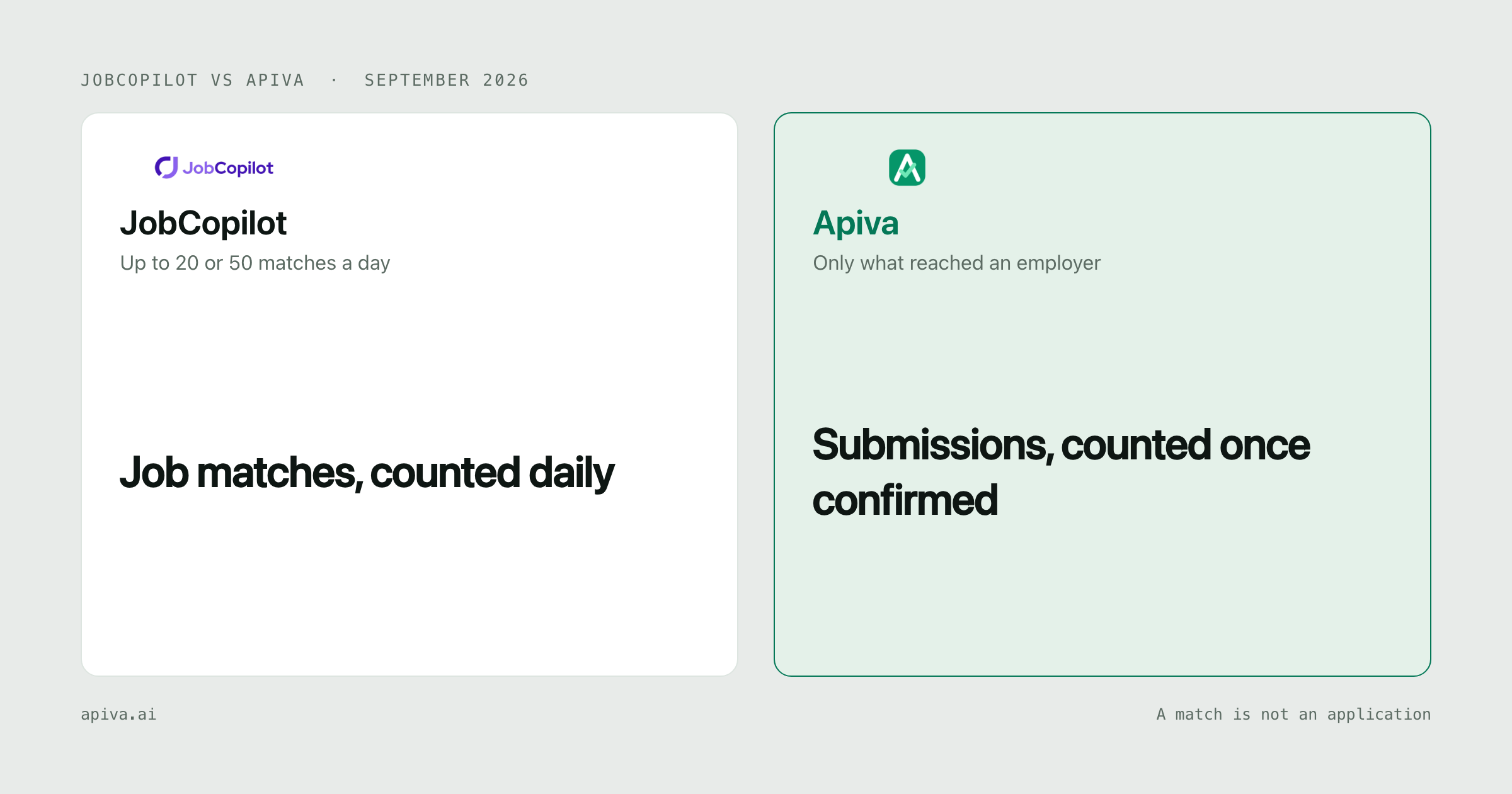
JobCopilot: an automated apply service with a lot of tooling around it, metered in job matches per day. Premium gives you one copilot and up to 20 matches daily, Elite gives you three copilots and up to 50. Priced from $0.93 a day. Trustpilot rates them 2.4 out of 5 from 101 reviews.
Apiva: you approve a job, software fills and submits it, a person finishes what software should not guess, and the credit is spent only once the submission is confirmed. Free tier of 25 applications a month, no card.
Want mock interviews, cover letters and hiring-manager outreach bundled into one subscription? Them.
Want to pay for applications that actually reached an employer, and nothing else? Us.
What JobCopilot actually is
The closest thing to us in shape. Software applies on your behalf, in volume, on a subscription.
The surface area is wide. One subscription carries a résumé builder, a cover letter builder, AI mock interviews, a job application tracker and a set of career tools. On Elite you also get credits to contact hiring managers directly, and résumé tailoring per application.
The metering is the part to look at closely. Both tiers are sold in job matches daily: up to 20 on Premium, up to 50 on Elite.
A match is a role their crawler found and decided suits you. It is not a form that was completed, and it is certainly not an application an employer received. Those are three different events and only the last one can get you hired.
Their feature list also includes "Save Job Applications for Review", which means some applications are set aside for you rather than sent. Sensible behaviour. It also means the number of matches you were sold is not the number of applications that went out, and the page does not say what the gap between them usually is.
We looked for what they publish about applications that fail or cannot be completed. On the pricing page, nothing. No failure policy, no statement about what happens to a form the software cannot finish, no credit back.
A match, a fill, and a submission are three different things
This category sells all three under one word, and the ambiguity is doing a lot of work.
A match is a crawler's opinion. A fill is a completed form sitting in a browser. A submission is the only one the employer can see.
Most tools meter the first, do the second, and stay quiet about the third. We wrote about the same slippage in Jobright vs Apiva, where the product ends at the fill, and in LazyApply vs Apiva, where the volume is real and the proof is not.
JobCopilot does go further than an autofill tool. It genuinely submits. The question is not whether it tries, it is whether you can tell afterwards which ones landed, and what you paid for the ones that did not.
That is the whole of our product argument, so we built the billing around it rather than the marketing.
What Apiva actually is
You approve jobs from a feed built on 50,000+ US company career pages, rescanned on a daily cycle. Or paste any US job link you found yourself.
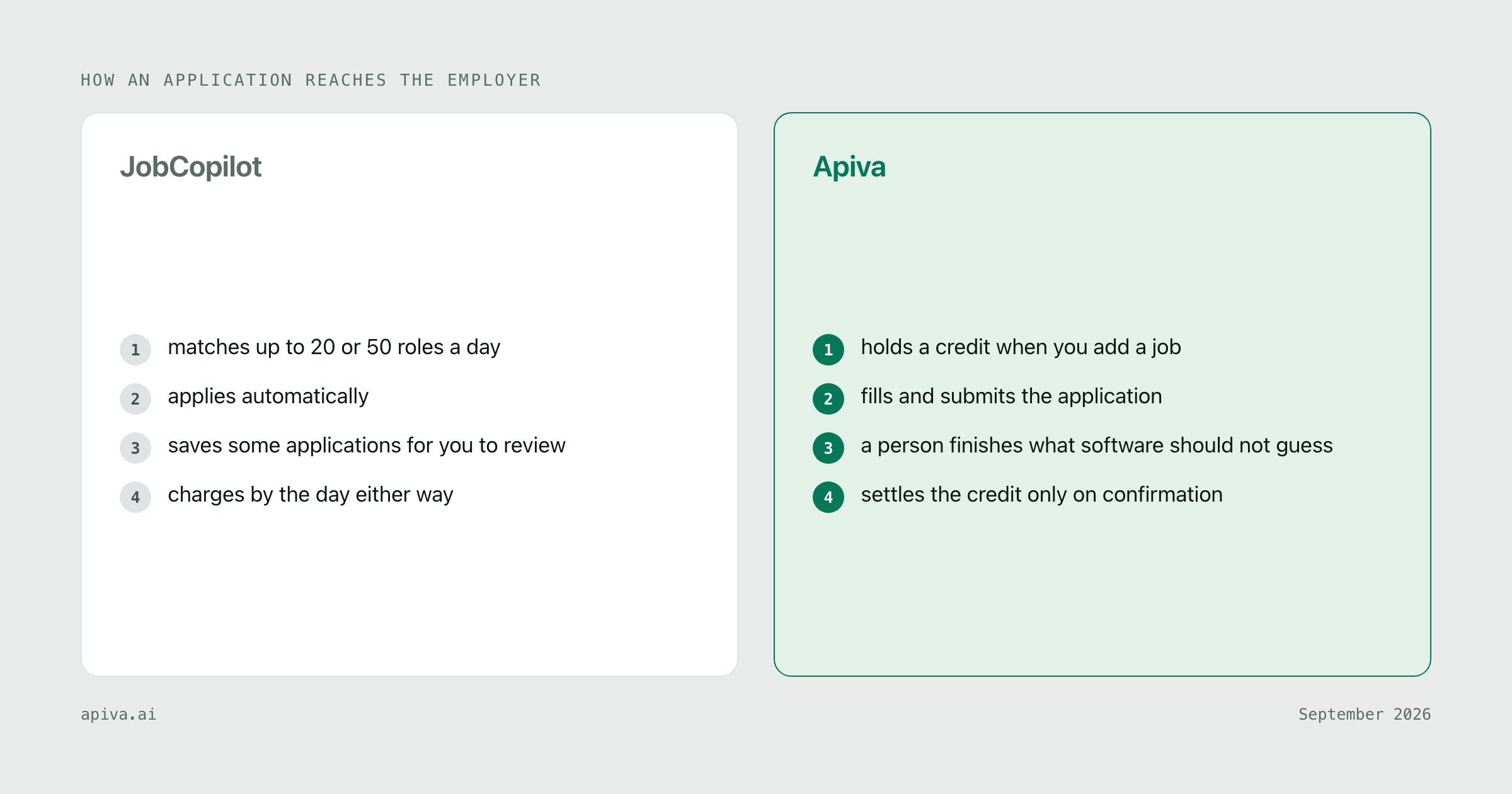
Software fills in the application, with your résumé rewritten for that role. You can review what changed before it goes.
When a form fights back, a person finishes it by hand. It pauses rather than guess, because a guess submitted under your name is worse than a pause.
The credit is held when you add a job and settles only when the submission is confirmed. Fail, and it comes back. That rule lives in the database, not in a promise on a landing page.
Our public counter reads 1,396 confirmed submissions today. Confirmed means a completed submission, not an attempt and not a match.
Side by side
| JobCopilot | Apiva | |
|---|---|---|
| Unit sold | Job matches per day | Confirmed submissions |
| Who applies | Software | Software, person finishes the rest |
| Proof | None published | Saved confirmation per application |
| When you pay | Per day, in advance | Only when a submission is confirmed |
| If it fails | Not published | Credit returned |
| Price shown | Per-day rate only | Full monthly price |
| Review standing | 2.4 / 5, 101 reviews | No comparable base |
| Free tier | None published | 25 confirmed applications a month |
The money
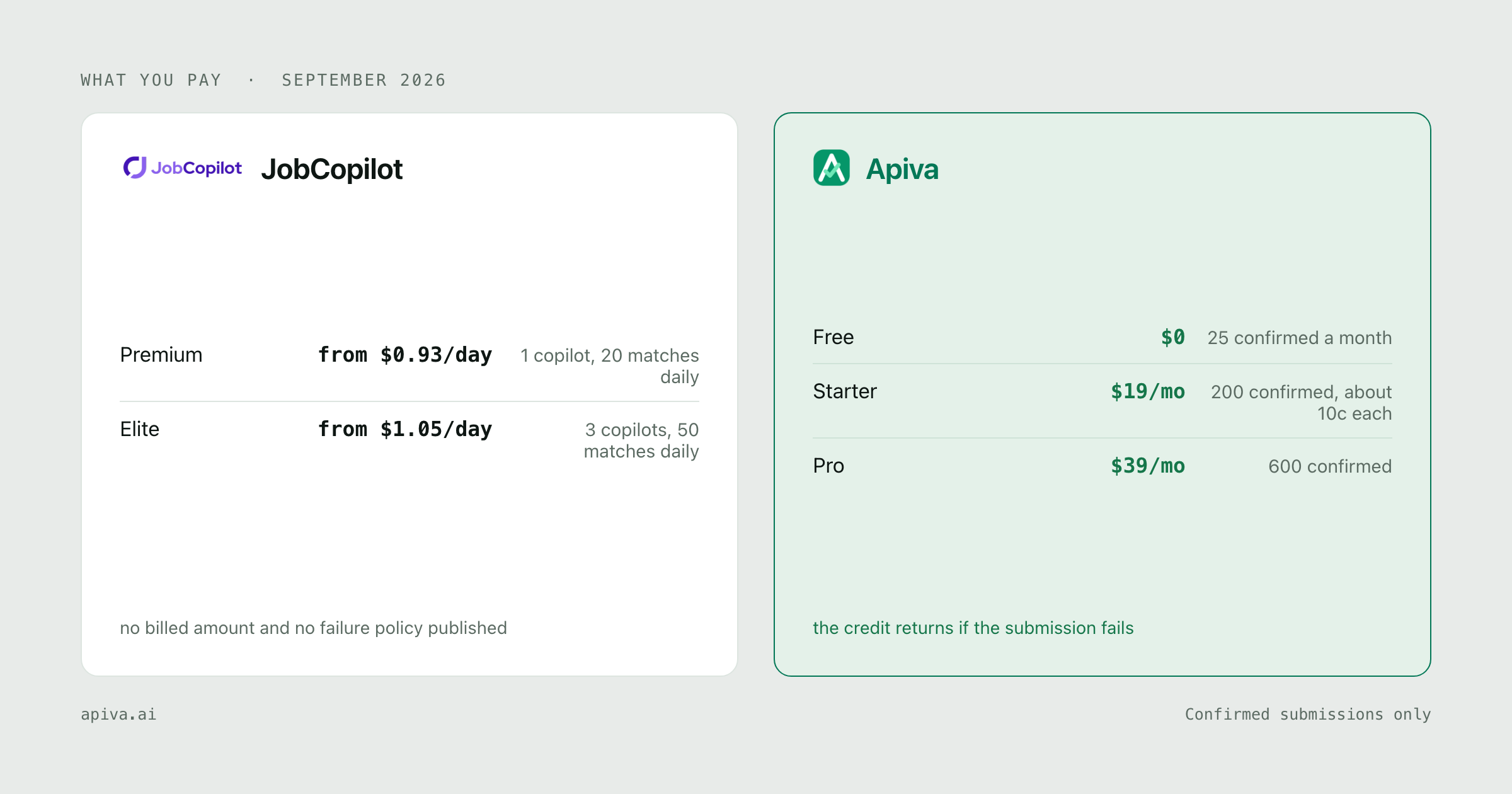
Their pricing page shows two tiers and one number each. Premium starts from $0.93 per day. Elite starts from $1.05 per day. Underneath sits the line "Weekly, Monthly and Quarterly plans available".
That is the entire pricing disclosure. Read it again and notice what is absent: the amount you are charged, and the day you are charged it.
We are not going to multiply $0.93 by thirty and print the result as their monthly price, because that would be our arithmetic and not their number. Here is what the page does support. "Starts from" names a floor, so the cheapest plan is the one quoted at $0.93 a day, and the weekly and monthly options cost more per day than that, not less. To learn the real figure you have to start checkout and hand over a card.
| Tier | Published rate | What it meters |
|---|---|---|
| Premium | From $0.93 / day | 1 copilot, up to 20 matches daily |
| Elite | From $1.05 / day | 3 copilots, up to 50 matches daily |
The deeper issue is what the day is measuring. A day passes whether or not a single application reached an employer. You are buying calendar time.
Ours is on one page and does not move. Free tier of 25 confirmed applications a month, no card. Starter $19 a month for up to 200, Pro $39 for up to 600, top tier $99 for up to 1,500. Quarterly prices are published at $49, $79 and $239, live when quarterly billing opens. Credits reset monthly and do not roll over.
That works out to roughly ten cents per confirmed submission on Starter. Not per match, not per attempt, not per day of subscription. Per application an employer actually received. See the pricing page for the rest.
Where JobCopilot wins
Range of tooling. Mock interviews, cover letters, a tracker and career tools in one subscription. We do none of them.
Hiring-manager outreach. Elite includes credits to contact people directly. That is a real channel and we have no answer to it.
Several copilots at once. Three parallel searches on Elite, which suits anyone hunting across two or three quite different roles.
Day rate, if you run hot. Someone applying heavily every single day may find a flat daily price works out well for them.
Where Apiva wins
We meter the thing you want. They sell matches per day. We sell confirmed submissions. Only one of those is an event an employer can see.
The price is on the page. All of it, with the billing period, before you reach a checkout. Theirs is a per-day floor and an invitation to find out later.
Failure has a defined consequence. The credit returns. Their pricing page says nothing at all about applications that cannot be completed, and silence there is not reassuring when the whole product is automated submission.
A person on the questions that matter. Sponsorship, disability disclosure, anything where a wrong answer becomes a false statement under your name. Those stop and wait for a human rather than taking the best available guess.
Review standing we are not hiding from. Theirs is 2.4 out of 5 from 101 reviews, read 20 September 2026, which Trustpilot labels Poor. We have no comparable review base, so this is not us winning on reviews. It is us pointing out that the complaint pattern in an automated-apply product is worth ten minutes of your reading time before you subscribe to one.
Bottom line
If you want a wide bundle of job-search tooling and direct outreach to hiring managers, and a daily rate suits how you work, JobCopilot covers ground we do not. Read their Trustpilot page first, then decide.
If you want to pay for applications that demonstrably reached an employer and nothing else, that is what Apiva is for, and 25 a month costs nothing to test.
Either way, do the check that settles it. Pick three applications and look for them in the employer's own portal. The dashboard belongs to the vendor; the portal belongs to the company deciding whether to interview you.
Checked September 2026. Spot something outdated or wrong about either service? Tell us and we'll fix it.
JobCopilot and its logo are trademarks of their owner, shown here to identify the product under comparison. We aren't affiliated with them and they haven't endorsed this.